From the moment designers take on their first client, the gap between school and professional design work is real. The biggest challenge for emerging designers isn’t learning how to design, it’s learning how to design within the realities of clients, constraints, and collaboration.
Bottom Line set out to close that gap by pairing a graduating student—the original designer of the Bluprint logo—with a real-world branding project paired with professional art direction.
The result was more than a logo refresh, it was mentorship in practice.
Background
Bottom Line is an organization with an ambitious and highly successful mission: to mentor high school students from under-resourced communities by providing the guidance and resources they need to enroll in college, persist, and graduate.
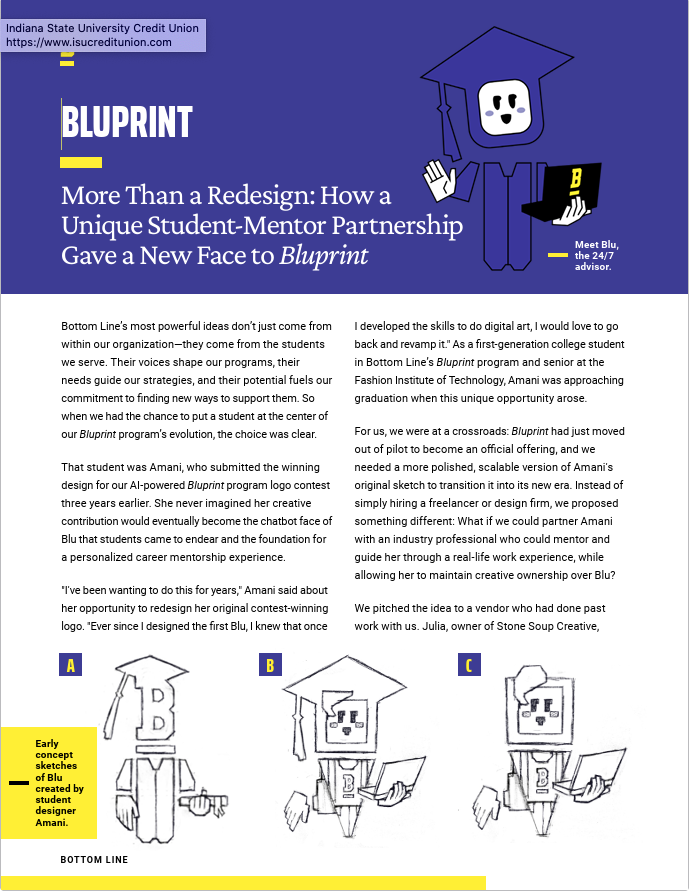
Bluprint is one of their core programs, offering degree-aspiring students personalized support through AI. At the center of this experience is Blu, a friendly chatbot advisor, who was originally introduced when AI advising was still emerging. Notably, the character was first designed by a Bluprint alumn, Amani Chandradatt, a first-generation college student with exceptional artistic talent.
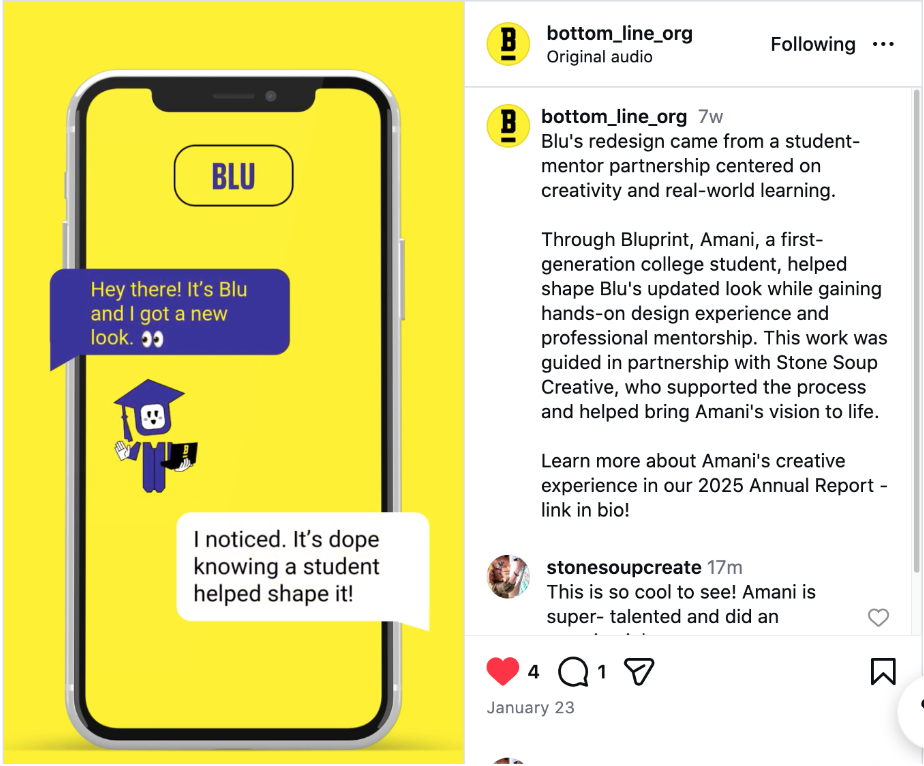
Fast forward to 2025. Following a broader organizational rebrand, Bluprint has matured into a well-established virtual advising program serving first-generation students seeking flexible support for their college years. With this evolution, Bottom Line’s communications team recognized the need to revisit Blu’s visual identity.
Given my background in nonprofit branding, they approached me with a unique collaboration: to mentor Amani—now on the verge of graduating from the Fashion Institute of Technology—through a logo refresh. The goal was to retain Blu’s original sense of friendliness and accessibility while introducing a more collegiate feel, reflecting the “BLU” in Bluprint: Bottom Line University.
This unconventional partnership resonated with my own experience in art school. While technical skills are emphasized in academic settings, hands-on professional experience is often limited, even with internship requirements. As I shared in a post-project interview with Bottom Line:
“There’s only so much time in class to prepare for a career. What’s often missing is real-world application.”
One of the most significant gaps is learning how to interpret and respond to client needs:
“In professional work, it’s not about personal expression—it’s about solving problems and achieving outcomes.”
If I could help even one emerging designer bridge that gap, the experience would be worthwhile.
Process
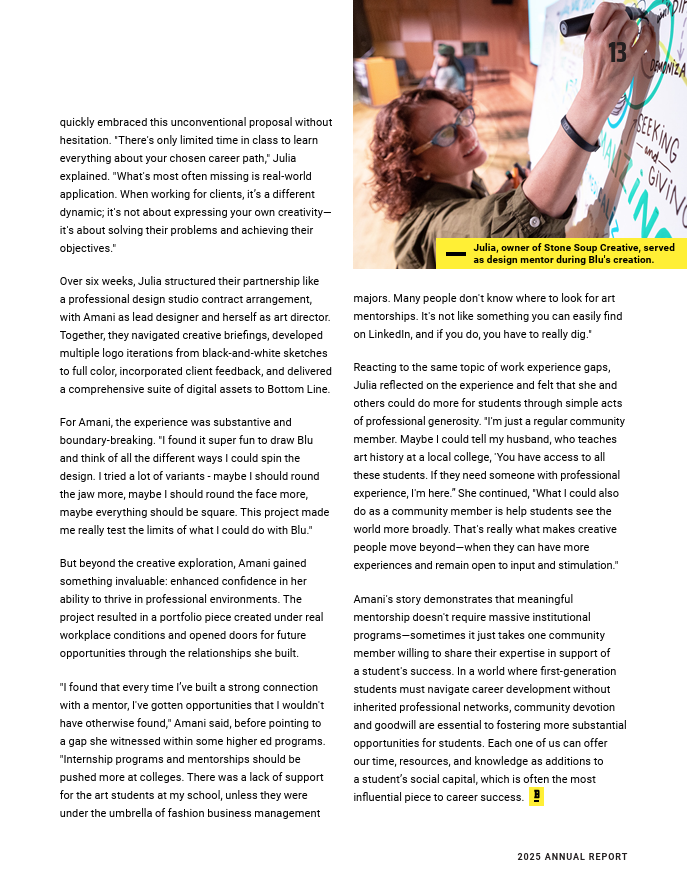
Because Amani already had strong technical ability, I structured the collaboration to mirror a professional studio engagement. I served as art director, Amani as lead designer/illustrator, and our contact at Bottom Line as the client.
This approach created an authentic, real-world experience, aligning with Bottom Line’s commitment to mentorship and career readiness, while giving Amani a valuable portfolio piece and practical client exposure.
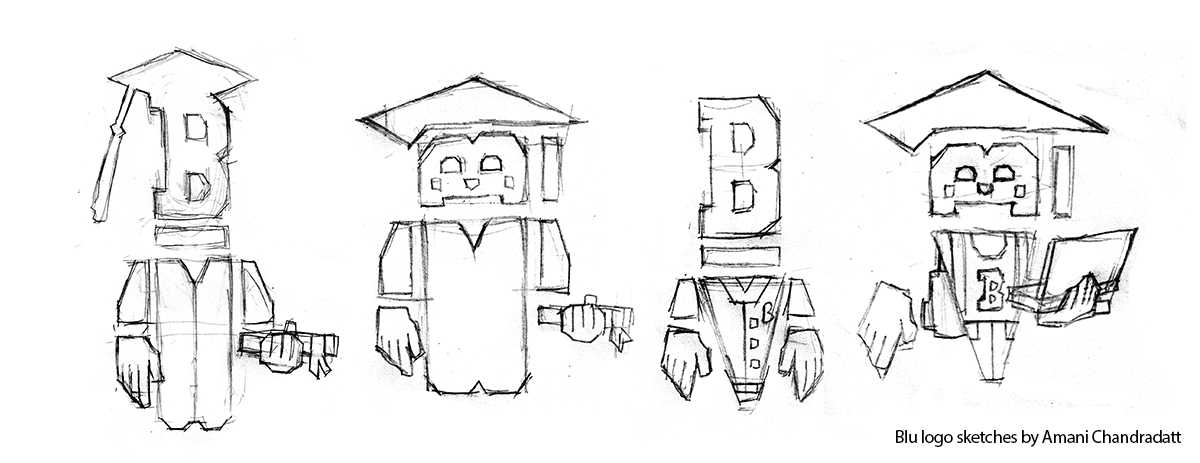
Over several weeks, we moved through a full design cycle: discovery, ideation, review, and revision. Early in the process, Amani reflected on her original concept:
I’ve always appreciated when software includes mascots to humanize the experience. Companion characters—especially in video games—help guide users and create a sense of connection.
My vision for Blu was a gender-neutral character that reflected Bottom Line’s brand and a sense of school identity. Because it’s a chatbot, I intentionally avoided human or animal traits, instead designing it as a robotic helper. I wanted something inclusive—able to resonate with anyone, regardless of background or identity. At its core, Bluprint is a tool to support students, and Blu should reflect that.”
The creative challenge was to build on this strong foundation while evolving the character. The updated design needed to maintain recognizability and continue to express trust, approachability, and a personable presence – values that are important to the Bottom Line community.
Result
The final logo was delivered for use across Bottom Line’s communications ecosystem, from the Bluprint platform, where Blu supports students with academics, financial aid, and internships, to outward-facing channels such as social media and program communications.
More than a visual update, the project reflects the intersection of mentorship, design, and mission-driven work: creating something that not only serves users, but also supports the growth of the next generation of creative professionals.
At its core, this project reflects what I bring to my work: the ability to shape ideas into visual solutions, whether through design, illustration, animation, or live visual storytelling; adapt across mediums; and support others in developing the skills to do the same.
Below is an article about the partnership that was included in the 2025 Bottom Line Annual Report: