Background
Bottom Line is an organization with an incredible – and incredibly successful – mission: they mentor high school students from under-resourced communities and backgrounds by providing guidance and resources to enter college, flourish, and graduate.
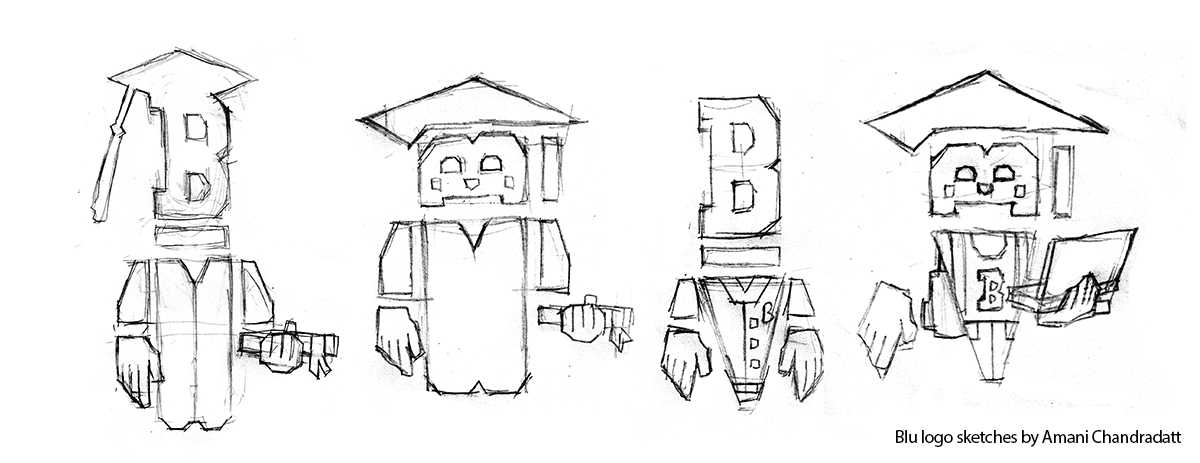
Bluprint is one of their core programs, offering degree-aspiring students a unique opportunity to receive support and guidance via AI. How does this work? Enter Blu, their friendly chatbot advisor. Blu was introduced in the early 2000s, considered cutting edge as the technology emerged; at the time AI advising was really new. What’s more, Blu’s visual character was initially designed by a Bluprint alumn: Amani Chandradatt, a young person with serious artistic chops and a first-generation college student.
Fast forward to 2025. Bottom Line has had a re-brand, and Bluprint is an established advising program offering first-gen students or students from an under-resourced community looking to go to college but would prefer virtual support because of the flexibility. The organization’s communications team feels now is the right time to re-visit the Blu logo.
Aware of my nonprofit branding background, they approached me with a unique partnership idea to mentor Amani – who was on the cusp of graduating the Fashion Institute of Technology in NYC – through the process of developing a logo re-fresh. The character should retain its original sense of ‘friendliness’ and ‘accessibility’ but with a more collegiate feel, which is fitting since the BLU in Bluprint stands for Bottom Line University.
My interest in the unconventional collaboration originated with my memory of art school, where learning how to draw and design were critical steps towards becoming a visual designer, but obtaining real-life skills and portfolio pieces proved to be a challenge: “There’s only limited time in class to learn everything about your chosen career path,” I explained in an interview for an article with Bottom Line after partnership was completed. “What’s most often missing is real-world application,” with one of the biggest differences between the “real world” from school assignments being the ability to understand and communicate your client’s business needs: “When working for clients, it’s a different dynamic; it’s not about expressing your own creativity—it’s about solving their problems and achieving their objectives.”
All these years later, if I could help just one person ease the transition from school to the work world, it would be a gratifying experience.
Process
Since Amani was already very skilled, I proposed treating the arrangement like a standard design studio client project: I would be the art director; Amani would be the lead creative designer/illustrator; and my contact at Bottom Line would be the client. This would allow Amani to get the experience of a typical process in a professional setting as she prepared to enter the job market, while aligning with Bottom Line’s commitment to mentorship and their focus on employability and career-readiness.
Over the course of several weeks, the process entailed meetings, ideations, reviews, and revisions. When we began, Amani articulated her rationale when asked to describe her original design inspiration:
“I always enjoyed it when software or services had mascots to make the experience more ‘human.’ Companion characters often exist in video games to assist the player. This approach is significant for its ability to create a personal connection with the user, resulting in something more than emotionless text guiding the person around. My original vision for Blu was a genderless character that utilized Bottomline’s color scheme and reflected school. It’s a chatbot, so I strayed away from animalistic or human characteristics to have it feel like a robot helper. I wanted to make a mascot that could fit with anyone, regardless of origin or assigned gender at birth. After all, Bluprint is first and foremost a tool to aid students. For Blu’s looks, I took a page from video game characters.”
The challenge would be to build on this and retain Blu’s recognizability – since many in the BL community valued her original logo – while at the same time communicating values such as being trustworthy, friendly, an ally, human-like, and personable.
Result
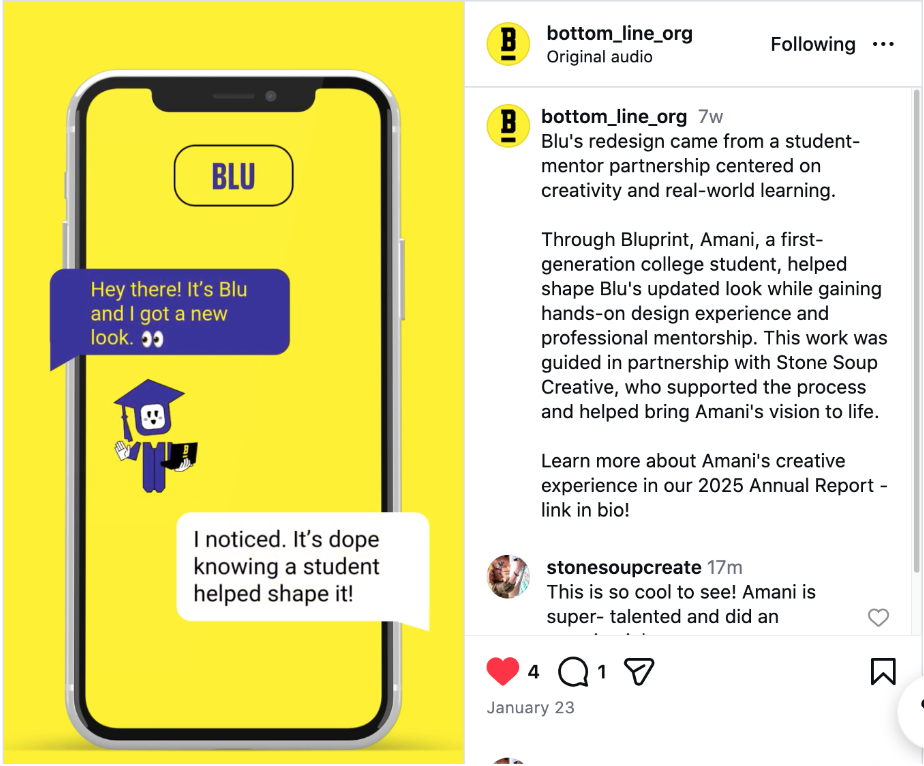
The final logo was delivered to Bottom Line for use across media – not only on the app platform, where Blu is available to advise and encourage Bluprint students and answer questions about academics, financial aid, and internships – but in more public-facing media such as the organization’s social media accounts, and in program communications to students.
Below is an article about the partnership that was included in the 2025 Bottom Line Annual Report:
More Than a Redesign: How a Unique Student-Mentor Partnership Gave a New Face to Bluprint
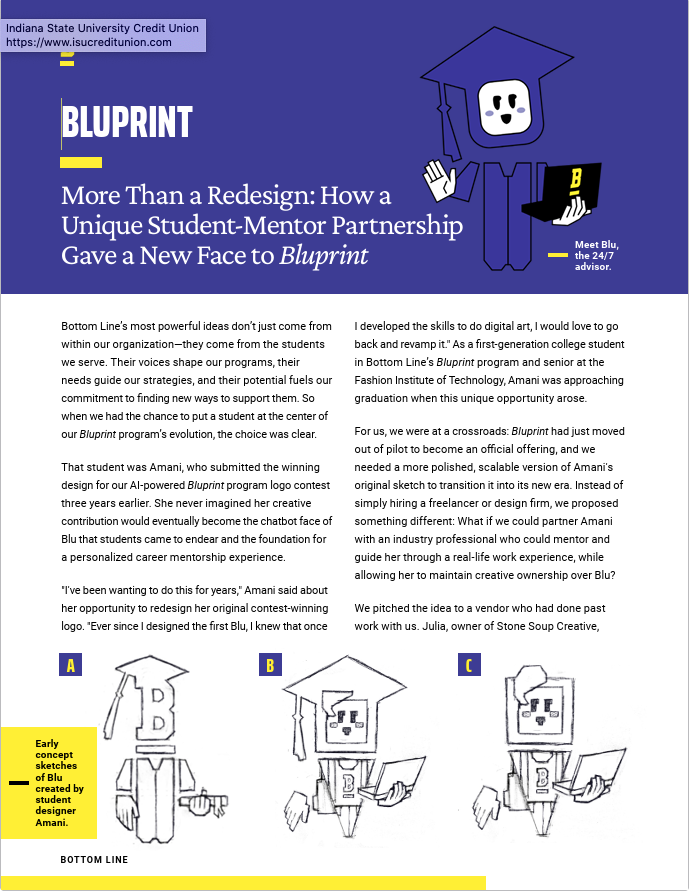
Bottom Line’s greatest ideas rarely come from our organization—they come from the students we serve. Their voices shape our programs, their needs guide our strategies, and their potential fuels our commitment to finding new ways to support them. So when we had the chance to put a student at the center of our Bluprint program’s evolution, the choice was clear.
That student was Amani, who three years earlier submitted the winning design for our AI-powered Bluprint program logo contest. She never imagined her creative contribution would eventually become the chatbot face of Bluprint that students came to endear and the foundation for a personalized career mentorship experience.
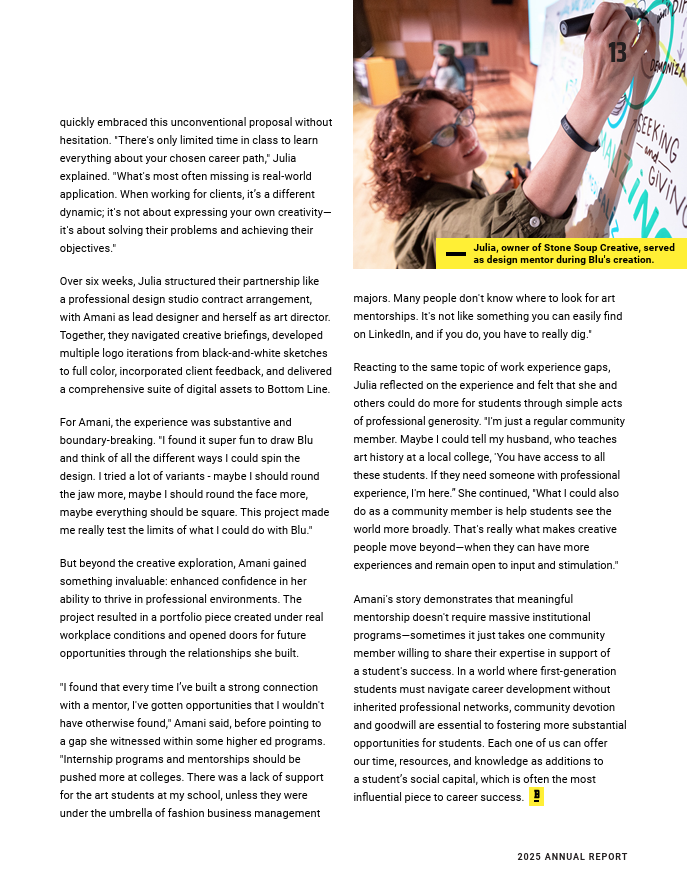
“I’ve been wanting to do this for years,” Amani said about her opportunity to redesign her original contest-winning logo. “Ever since I designed the first Blu, I knew that once I developed the skills to do digital art, I would love to go back and revamp it.” As a first-generation college student in Bottom Line’s Bluprint program and senior at the Fashion Institute of Technology, Amani was approaching graduation when this unique opportunity arose.
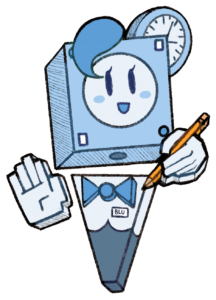
For us, we were at a crossroads: Bluprint had just moved out of pilot to become an official offering, and we needed a more polished, scalable version of Amani’s original sketch to transition it into its new era. Instead of simply hiring a freelancer or design firm, we proposed something different: What if we could partner Amani with an industry professional who could mentor and guide her through a real-life work experience, while allowing her to maintain creative ownership over Blu?
We pitched the idea to a vendor who had done past work with us. Julia, owner of Stone Soup Creative, quickly embraced this unconventional proposal without hesitation. “There’s only limited time in class to learn everything about your chosen career path,” Julia explained. “What’s most often missing is real-world application. When working for clients, it’s a different dynamic; it’s not about expressing your own creativity—it’s about solving their problems and achieving their objectives.”
Over six weeks, Julia structured their partnership like a professional design studio contract arrangement, with Amani as lead designer and herself as art director. Together, they navigated creative briefings, developed multiple logo iterations from black-and-white sketches to full color, incorporated client feedback, and delivered a comprehensive suite of digital assets to Bottom Line.
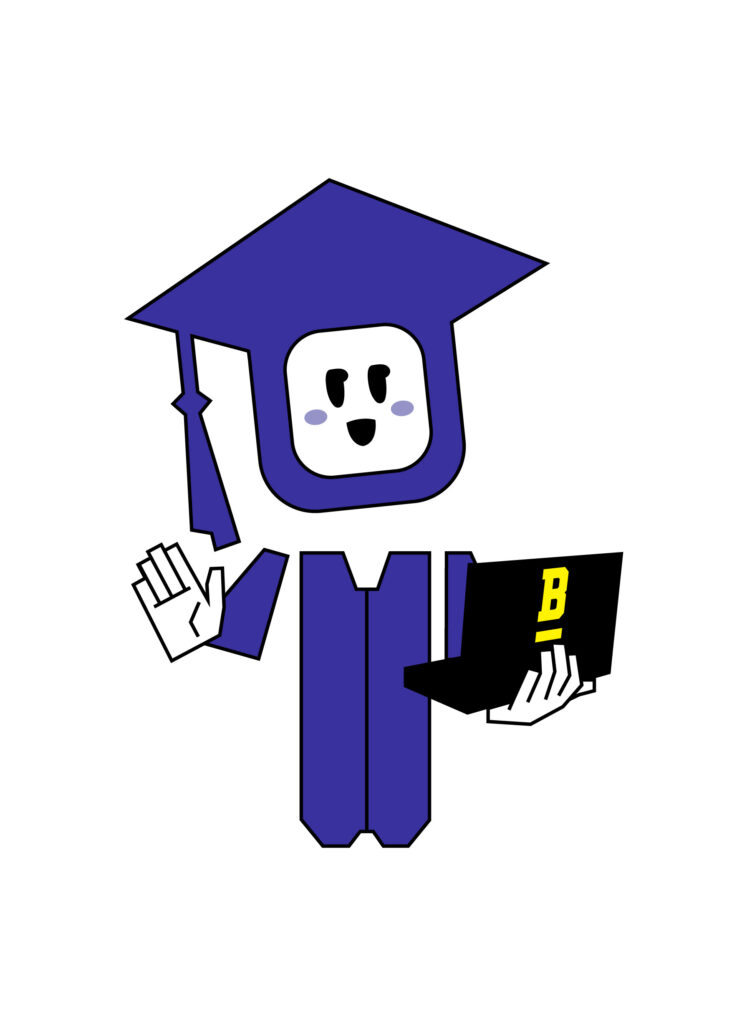
For Amani, the experience was substantive and boundary-breaking. “I found it super fun to draw Blu and think of all the different ways I could spin the design. I tried a lot of variance – maybe I should round the jaw more, maybe I should round the face more, maybe everything should be square. This project made me really test the limits of what I could do with Blu.”
But beyond the creative exploration, Amani gained something invaluable: enhanced confidence in her ability to thrive in professional environments. The project resulted in a portfolio piece created under real workplace conditions and opened doors for future opportunities through the relationships she built.
“I found that every time I’ve built a strong connection with a mentor, I’ve gotten opportunities that I wouldn’t have otherwise found,” Amani said, before pointing to a gap she witnessed within some higher ed programs. “Internship programs and mentorships should be pushed more at colleges. There was a lack of support for the art students at my school, unless they were under the umbrella of fashion business management majors. Many people don’t know where to look for art mentorships. It’s not like something you can easily find on LinkedIn, and if you do, you have to really dig.”
Reacting to the same topic of work experience gaps, Julia reflected on the experience and felt that she and others could do more for students through simple acts of professional generosity. “I’m just a regular community member. Maybe I could tell my husband, who teaches art history at a local college, ‘You have access to all these students. If they need someone with professional experience, I’m here.” She continued, “What I could also do as a community member is help students see the world more broadly. That’s really what makes creative people move beyond—when they can have more experiences and remain open to input and stimulation.”
Amani’s story demonstrates that meaningful mentorship doesn’t require massive institutional programs—sometimes it just takes one community member willing to share their expertise in support of a student’s success. In a world where first-generation students must navigate career development without inherited professional networks, community devotion and goodwill are essential to fostering more substantial opportunities for students. Each one of us can offer our time, resources, and knowledge as additions to a student’s social capital, which is often the most influential piece to career success.
– Bottom Line 2025 Annual Report, pages 12-13.